
Tazewell VINELink Release Coverage
Illinois VINELink is a custody-status search and notification service fed by participating agencies. It can report an agency's custody event for one matched person and let a user register for later notice. It is not the Tazewell County Sheriff's release log, a court disposition, or a permanent discharge archive. Research found no static official participation list that proves the Tazewell County Jail's current live behavior, so confirm county coverage in the portal or with VINE and the Sheriff.
A county custody event, an IDOC prison status, and a federal release belong to different systems. VINELink may carry a participating jail event. The IDOC search and archive hold Illinois prison and supervision records. The federal Bureau of Prisons uses its own locator, while the U.S. Marshals Service has no comparable public national person locator. ICE has a separate current or recent detention locator. None of these tools universally proves release from all government custody.
The Illinois portal displayed in this capture is the correct starting point for an Illinois person search.
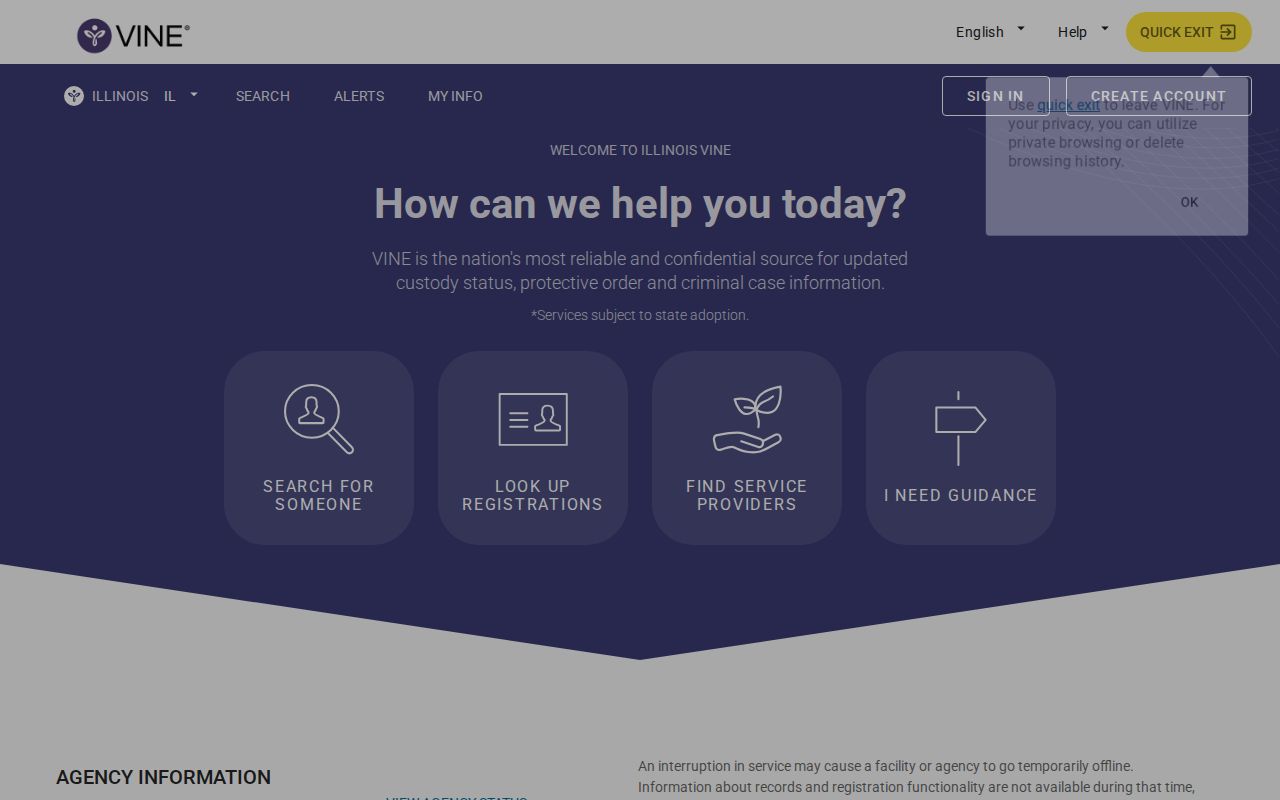
Starting on the state-specific landing page reduces the risk of searching another jurisdiction's records or alert options.
Search Tazewell VINELink Records
A specific-person check must begin with identity, not a status label. Common names can produce several records. A spelling variation can produce none. Use an identifying number when available, and compare every displayed identifier before opening or registering against a record. The portal is dynamic, so the exact controls and available fields can change.
- Open the Illinois portal and choose the person or offender search shown in the live interface.
- Enter the available name or identifying-number fields. Use the full legal name and known details rather than a surname alone.
- Review all returned records. Compare identification details, agency, location, and any displayed number before selecting a person.
- Open the matching individual record. Read custody status, location, and event information together.
- If the record reports release or no current custody, describe it as the participating agency's VINE status. Do not add a release reason the screen does not provide.
- Confirm exact date, type, authority, and destination with the Sheriff release entry, IDOC record, or correct custodian.
A “no result” message is not proof of release. It can follow a transfer, delayed reporting, spelling or identifier mismatch, privacy limits, agency nonparticipation, or limited historical display. For a named county-jail booking, the full Tazewell County release search path pairs the current Sheriff table, court case, and release-record request.
Tazewell VINELink Release Fields
Read only the fields actually shown on the matching live record. VINE may report custody status, location, identifying information, and an event. Available labels can vary by agency and configuration. A reported release event is useful for timing and notification, but it does not replace the local release entry that records the authority and legal type.
| Displayed item | What it can establish | What it cannot establish alone |
|---|---|---|
| Identity details | Whether the result likely matches the intended person | A match based on name alone |
| Custody status | The participating agency's reported status | Freedom from every other agency's custody |
| Location or agency | Which reporting custodian is tied to the event | The full legal reason for transfer or release |
| Event information | A reported custody change, when displayed | The Sheriff's official release type, authority, and destination |
| Notification action | Whether registration is offered for that record | A guaranteed delivery method or instant update |
For the Tazewell County Jail, request the existing release record when exact physical exit matters. The state inspection identifies date, time, and authority as core release-record elements. For someone released from an IDOC prison, compare VINE with IDOC status, admission, release, and sentencing information. A person physically released on parole or mandatory supervised release may remain publicly displayed until sentence completion.
Register Tazewell Release Alerts
Register from the correctly matched individual record. This ties the request to the intended person and reporting agency. The modern service may offer telephone, email, or text, but delivery methods can vary with the live record and agency. Select only an option displayed in the Illinois interface.
- Open the verified individual record and select the notification or “Get notified” action.
- Choose one of the delivery methods currently offered for that record.
- Enter the telephone number or electronic destination carefully. A wrong digit or address can prevent notice.
- For telephone calls, create the requested PIN. Use it to acknowledge an automated call and help stop repeat calls.
- For email or text, complete any confirmation or verification step shown by the service.
- Save the registration details. Return to VINELink when an alert must be changed or canceled.
Notification is prospective. It works best when set before the custody change. No official fixed Tazewell retention window was found for older VINE events, so VINELink should not be treated as a public 24-hour, 72-hour, or permanent release list. Keep the person's identifiers and the name of the reporting agency available for later confirmation.
Alerts can reduce repeated manual checks, yet they cannot promise the precise time a person walks out. Jail processing, another hold, a transfer, or data timing may separate the legal event from a message. If a notice conflicts with an agency record, contact the custodian that reported the event.
Tazewell Registries and VINELink
The Illinois State Police Sex Offender Registry is a separate public system for a narrow group of people who have a legal registration duty. It may help corroborate identity or community presence for a covered person. It is not a jail release record, and it does not replace VINELink, IDOC, the Sheriff, or the court.
The registry search screen shown here illustrates that the registry has its own scope and search route.
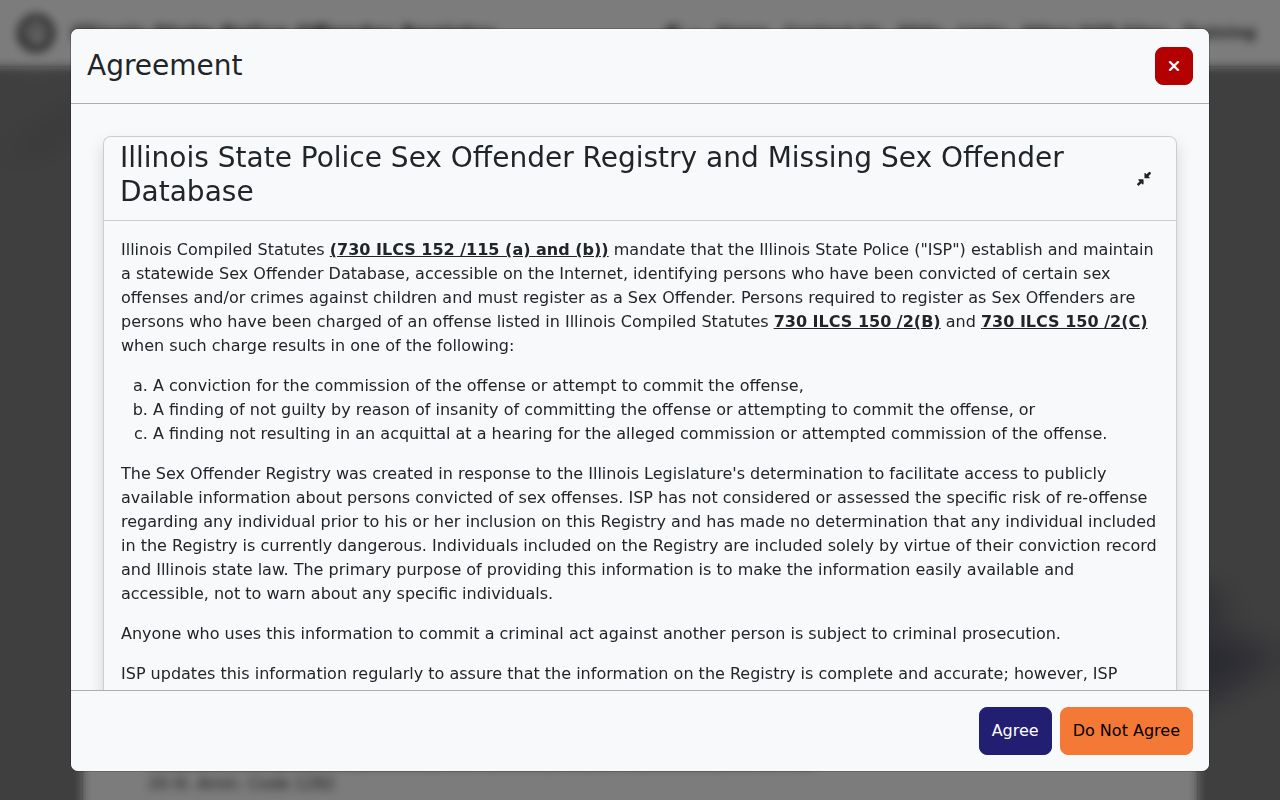
Presence applies only to a person subject to registration. Absence proves nothing about custody, release, innocence, or case history.
When both systems return a possible match, compare the photograph and identity details rather than the name alone. Then return to the responsible custody agency for the release date and type. This narrow use prevents registry status from being turned into a claim it cannot support.
Confirm Tazewell VINELink Releases
Match the confirmation source to the custody type. For a Tazewell County Jail detainee, search the Sheriff current-custody table only to see whether the person remains listed. Absence is a lead, not a released result. Check the Circuit Clerk case history and request the Sheriff's existing release entry for date, time, authority, release type, and destination if transferred.
For an Illinois prison term, use the IDOC Individual in Custody Search. IDOC says the public system covers people incarcerated or on parole, then removes the profile after sentence completion. If a known former prisoner is missing, use IDOC's contact form with “Record Search” for the archive. This differs from a VINELink event and from final discharge.
For someone at FCI or Federal Prison Camp Pekin, use the BOP Inmate Locator. “Released” or “Not in BOP Custody” means BOP custody ended, not that all custody or federal supervision ended. Federal pretrial custody may belong to USMS and may not appear in BOP. For genuine immigration custody, use ICE's locator and ERO contact route. Do not assume Illinois VINE covers BOP, USMS, or ICE.
County, state, and federal records may overlap during a transfer. A person can leave the Tazewell roster for IDOC or a federal handoff without entering the community. Likewise, a court release order can precede physical exit because another hold or processing step remains. Read the status with its agency, date, and event type.
The Tazewell court portal provides another check when the jail event and VINE status do not explain the outcome. Search the matching criminal case and read its dated history for pretrial release, dismissal, sentencing, probation, remand, or later warrant activity. Remote court access is narrower than courthouse access under Illinois policy, so a missing document online should lead to the Circuit Clerk's copy route, not a claim that the event never occurred.
Records requests remain the precise fallback. The Sheriff's FOIA channel accepts a request for existing records that show booking date, release date and time, disposition or type, releasing or transferring authority, and destination if transferred. Supply the person's full name, distinguishing details, and the approximate custody dates. Ask for electronic delivery where practical and for segregable nonexempt portions if some material is withheld.
An IDOC result needs a different reading. The public search can display a person who has physically left prison but remains on parole or mandatory supervised release. Status, location, admission, release, and sentencing fields should be read as a set. Once the sentence is complete, IDOC says the profile is removed from public display. At that point, choose “Record Search” on the agency contact form and provide the full name, birth date, approximate admission year, known facility, conviction county, and incarceration dates. A VINE notice cannot replace that archived state record.
Federal custody has its own trap in Tazewell County. A published U.S. Marshals Service agreement for the county Justice Center states that a federal detainee was to be released only to the committing federal agency or a marshal or designated agent. The agreement dates to 2006, and its current operational status was not independently verified. Still, it shows why disappearance from a county roster may represent an agency handoff rather than community release. Confirm through the federal docket and actual federal custodian.
VINE is most useful as an early signal. The agency record is the proof source. If the portal has no result, do not switch to a commercial list or infer discharge. Check spelling and identifiers, confirm participation, classify the custody type, and move to the Sheriff, IDOC, BOP, USMS, ICE, or court route that actually holds the record.
Note: Save the alert record, event wording, and time received, then ask the reporting agency for the official release or transfer entry.