
Tazewell Projected Versus Actual Release
A projected date is an estimate produced from a sentence and the credit rules that apply to it. IDOC uses the term “projected parole date” when discussing a change caused by Earned Sentence Credit. That date marks a possible transition out of prison confinement. It may begin parole or mandatory supervised release, often called MSR, rather than end every part of the sentence. Final discharge means the sentence and supervision have ended. Those events should not be treated as the same record.
Actual release is the event recorded after the agency completes its checks and transfers or discharges the person. The Tazewell County Justice Center records the date, time, and authority for a release. Another warrant, detainer, transfer order, or court action can prevent community release even when one term appears complete. A detainer is a notice that another agency may take custody. A projected date therefore describes a calculation, while the later jail or IDOC record confirms what occurred.
Tazewell Release Dates by Custody
The correct route depends on where the person is held and why. Someone awaiting trial at the Tazewell County Jail usually has no fixed sentence-based release date. A court decision, pretrial condition, bond processing, dismissal, or other legal event may lead to release, but processing and holds still matter. A person serving a county jail sentence may have a calculable end date, subject to lawful credit and the Sheriff’s records. A person sentenced to Illinois prison belongs in the IDOC system. Federal prisoners at FCI Pekin use the Bureau of Prisons locator, not the Illinois calculation.
| Custody situation | Best source | What the date means |
|---|---|---|
| Pretrial county detainee | Circuit court and Tazewell County Jail | No fixed sentence date; court action and holds control |
| County jail sentence | Jail records and sentencing order | Local calculation after lawful custody credit |
| IDOC sentence | IDOC Individual in Custody Search | Projected custody-release or parole milestone |
| Federal sentence | BOP Inmate Locator | Federal release information, not an Illinois date |
This division prevents a common error. The Tazewell Sheriff’s current-custody table is not a future-date calculator, and an IDOC result does not cover a person whose only confinement is in the county jail.
Find a Tazewell Projected Release
For an Illinois prisoner, begin with the official IDOC search landing page and continue to the live Individual in Custody Search. The form accepts last name, IDOC number, or birthdate. Compare the name, IDOC number, vital details, institution, status, admission data, release data, and sentence information. A name-only match is weak because several people may share a name.
- Identify whether the person is in Tazewell County, IDOC, or federal custody.
- For IDOC, search by IDOC number when known; otherwise use surname or birthdate and compare all identifiers.
- Read the exact date label with current status, institution, sentence, and admission information.
- For county custody, obtain the sentencing order through the Circuit Clerk and ask jail records for the current computation.
- Recheck close to the date, then confirm the later release or transfer record with the agency that held the person.
The Tazewell County released-inmate search explains how the county release record, court history, and state record fit together after an exit. It is especially useful when the person vanishes from a live roster.
The official live form shows the available IDOC search modes. Review the source form before relying on a copied date.
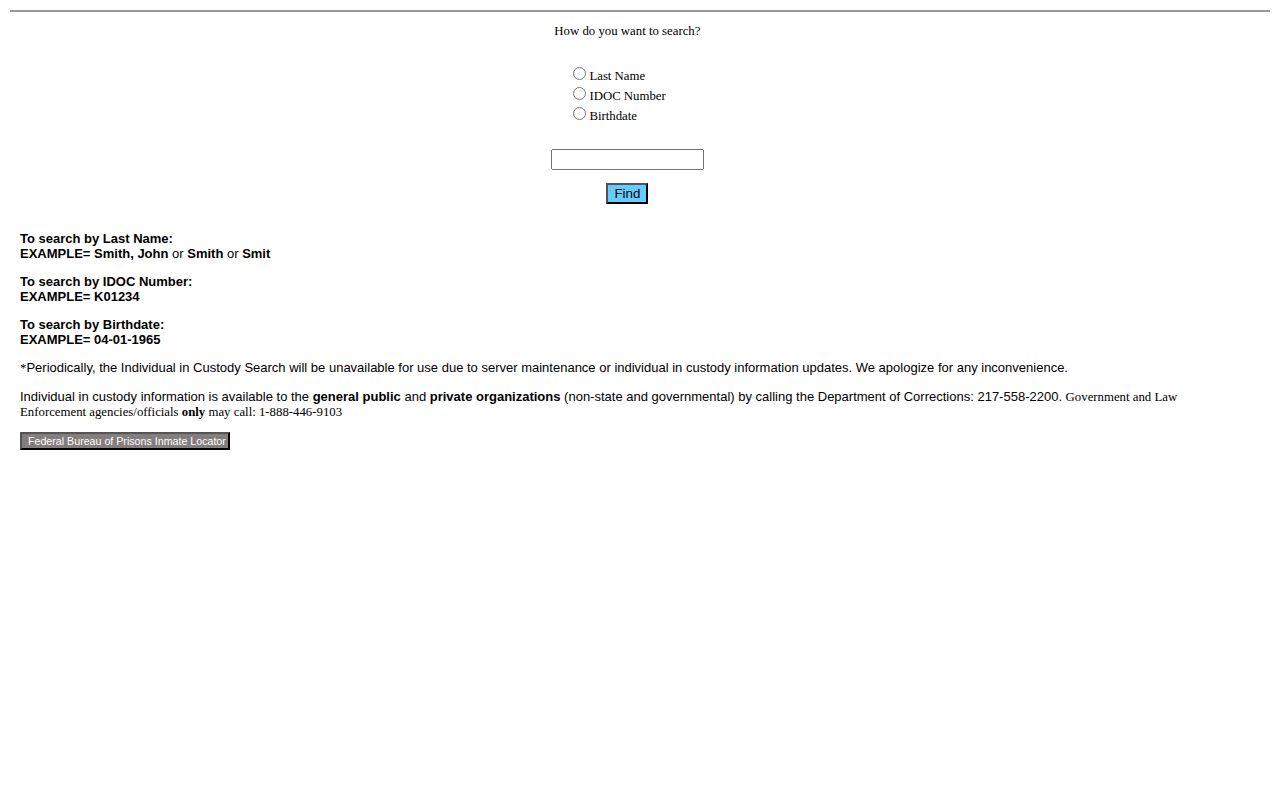
The screenshot confirms that Illinois searches are organized by surname, IDOC number, and birthdate rather than by Tazewell County alone.
Illinois Credit Shapes Tazewell Releases
The calculation begins with the court-imposed sentence, prior custody credit, and the law applicable to the offense and offense date. Illinois 730 ILCS 5/3-6-3 contains sentence-credit rules, service floors, and exclusions. It cannot be reduced to one formula. Consecutive sentences run one after another, while concurrent sentences run at the same time, subject to the governing order and law. Statutory versions and sentencing details can change the result.
IDOC says discretionary Earned Sentence Credit may be up to 180 days. Eligibility requires more than 60 days in IDOC custody and no statutory exclusion. IDOC considers assessments, the offense and record, conduct in the institution, programs, and required treatment. Eligibility is not an award. IDOC states that it cannot predict whether or when a specific eligible person will receive credit. If awarded, the adjustment may change the projected parole date and appear in the public profile.
- Custody credit
- Time the court or agency lawfully counts toward the sentence.
- Earned Sentence Credit
- A discretionary IDOC credit, subject to eligibility, review, and possible loss.
- MSR
- Mandatory supervised release, a period of community supervision after prison confinement.
- Final discharge
- Completion of the sentence and any required supervision.
The IDOC public FAQ explains both the credit caution and the limits of public profiles.
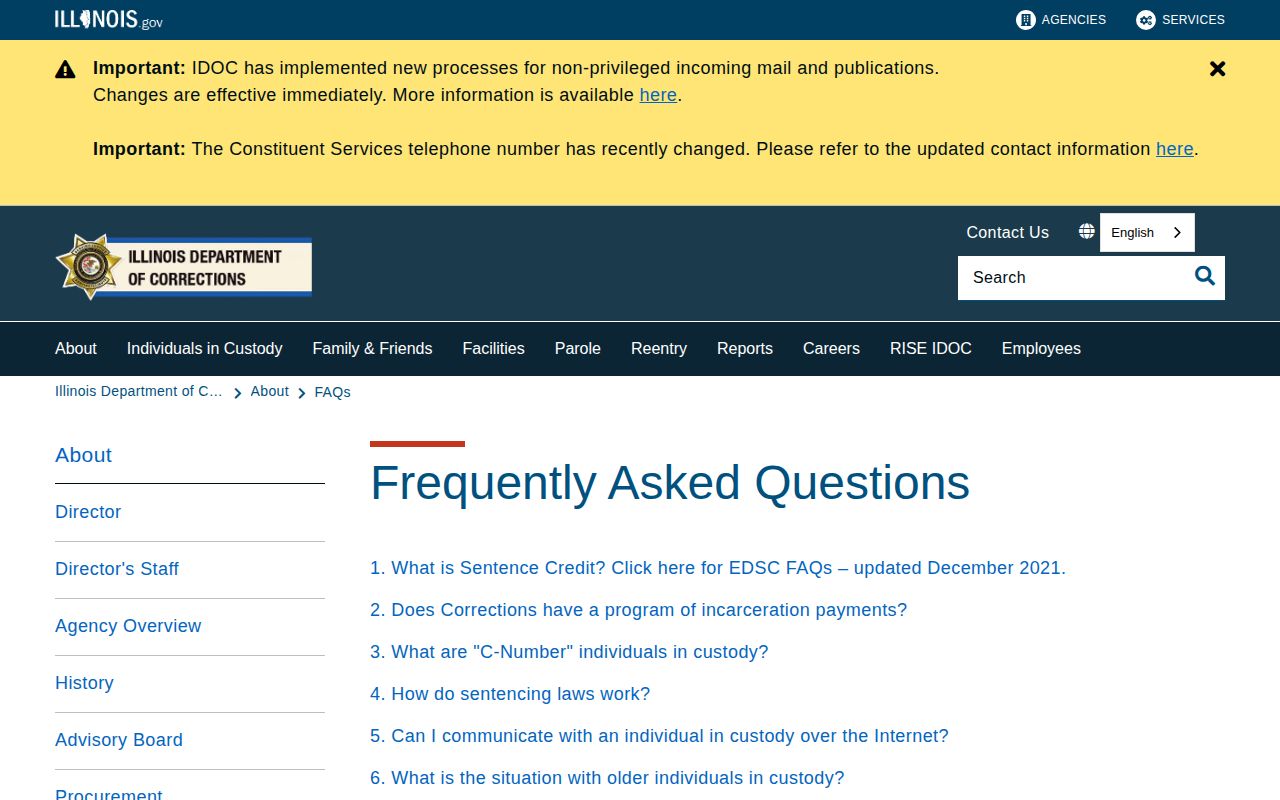
That guidance matters after release because IDOC says public profiles cover people incarcerated or on parole, then disappear after sentence completion.
Tazewell Release Service Floors
Illinois truth-in-sentencing law does not impose one universal 85 percent rule. Some covered sentences require 100 percent service. Some specified violent offenses generally require 85 percent, while current law includes other category-specific floors such as 75 or 60 percent in certain circumstances. IDOC’s plain-language material notes that qualifying first-degree murder terms are served at 100 percent. The precise conviction, offense date, sentence date, and applicable statutory text control.
Multiplying every sentence by .85 can produce a false Tazewell County release date. The sentence may include several counts, different credit treatment, consecutive terms, or a later correction. The public profile is a useful current estimate, but an exact calculation question belongs with IDOC and the sentencing record. Under the same statute, notice to the relevant State’s Attorney is required at least 14 days before a specified discretionary credit grant causes an earlier release. That notice is an administrative safeguard, not a promise of release 14 days later.
Note: Court sentence length and projected prison release are related records, but neither alone proves the day a person entered the community.
Why Tazewell Release Dates Move
A valid calculation can change after it first appears. IDOC may award discretionary credit, revoke credit after discipline, correct prior custody credit, or recalculate linked sentences. Courts may amend a sentence or enter an order that affects custody. Another county, state, or federal agency may lodge a detainer. The Prisoner Review Board may set conditions or decide a specialized parole matter, while IDOC performs the time calculation. Each event has a different source record.
| Factor | Possible effect | Where to verify |
|---|---|---|
| Earned credit award | Moves the projected parole date earlier | IDOC profile and calculation record |
| Credit loss | Moves the estimate later | IDOC disciplinary and master record |
| Court correction | Changes sentence or credited time | Tazewell Circuit Clerk case history |
| Detainer or warrant | May cause transfer instead of community release | Holding agency and requesting agency |
| Parole or MSR action | Changes conditions or custody status | IDOC and Prisoner Review Board |
Because these events are recorded at different times, an old screenshot or informal calculation should not control. Use the newest official date and ask the responsible agency about a conflict.
Tazewell Jail Sentence Computation
County jail terms need local confirmation. The Tazewell Circuit Clerk record can show the sentence, remand, probation, disposition, and jail-credit language. The Sheriff holds the custody and release record. Research found no public county sentence calculator and no published universal local good-time formula. A request should identify the person and custody episode, then ask for existing records that show the sentence computation, credited days, expected end date, and any recorded release date, time, and authority.
Intermittent confinement is a separate local arrangement. The Sheriff’s weekend rules concern court-ordered periods served in blocks, not a normal daily release schedule and not a substitute for a sentence computation.

The local rules show why a person may enter and leave under a court-set schedule without reaching final release from the sentence.
Can Tazewell Earned Credit Change?
Yes. This is the central Illinois computation quirk for a projected date. IDOC cannot forecast if or when an eligible person will receive discretionary Earned Sentence Credit. An award can revise the projected parole date, and institutional behavior can lead to credit loss. Even a date taken from an official profile is a moving administrative estimate until the custody event occurs.
Recheck IDOC rather than preserving an early estimate as fact. If the profile has disappeared after sentence completion, use the IDOC contact form, select “Record Search,” and provide the full name, birthdate, approximate year received, and known facility, conviction county, or incarceration dates. The archive route is stronger than inferring a discharge from “no result.”
Note: IDOC credit applies to an Illinois prison sentence; it should not be copied onto a county or federal sentence.
Confirm a Tazewell Release Date
Near the projected date, check the same custody system again. For IDOC, compare the current status and date fields, then use the archive route after full completion. For a county detainee, ask the Sheriff for the release entry showing date, time, and authority. Court history can explain the order, but an order may be followed by jail processing or another hold. For federal custody at FCI Pekin, use BOP rather than IDOC.
Illinois VINELink may provide a custody-change alert for a participating agency and a correctly matched individual. It is a notification layer, not the legal release record. The VINELink Check describes registration and its custody limits. Confirm any alert with the jail, IDOC, or federal custodian before describing the event as community release.