
Tazewell 72-Hour Release Records
Tazewell County supplies no separate or combined 72-hour released-inmate feed. The official Sheriff custody lookup has no released tab or window selector. Its declared fields cover BookDate, BookTime, DetaineeID, name, age, race, sex, charge, and agency. Release date, release time, reason, destination, photograph, cadence, and retention are absent.
The table is valuable for one narrow task: checking who is listed in current county custody. It cannot be turned into a historical three-day list by looking for missing names. A disappearance can result from transfer, correction, delay, or actual community release. Comparing saved roster snapshots would still fail to reveal the authority and destination. The Sheriff’s recorded release entry is the source that answers those questions.
Request Tazewell Three-Day Releases
Define the 72 hours with exact beginning and ending timestamps. That avoids uncertainty about whether “three days” means calendar dates or a rolling period. The Sheriff FOIA process accepts email at foiasheriff@tazewell-il.gov and in-person requests through Civil Process, Tazewell County Sheriff’s Office, 101 S. Capitol Street, Pekin, Illinois 61554. The posted in-person hours are Monday through Friday, 9 a.m. to 5 p.m.
- State both timestamps and the time zone for the requested 72 hours.
- Ask for the existing release log or records sufficient to identify releases in that period.
- Seek names or identifiers, booking dates, release dates and times, dispositions or authorities, and transfer destinations.
- Request an electronic response and nonexempt portions if some fields require redaction.
- Reconcile transfers and court-authorized releases with the agency records that follow.
An agency need not create a new analysis when no report exists. Asking for existing entries respects that limit. Jail operations at 309-478-5600 may help with current questions, but a formal record is the more durable response for a complete three-day interval.
Tazewell 72-Hour Record Fields
The county’s 2025 inspection establishes that release records include date, time, and authority. A focused request can add the maintained disposition or destination needed to distinguish freedom from transfer. These fields give the requested three-day set a sound basis.
| Requested field | Why it matters |
|---|---|
| Name and detainee ID | Separates people with similar names and ties the row to one admission. |
| Booking date | Identifies the correct custody episode. |
| Release timestamp | Places the event inside or outside the exact 72-hour interval. |
| Release authority or type | States the recorded basis for ending county custody. |
| Transfer destination | Shows when the person remained confined under another custodian. |
A current roster has none of those release fields. Its booking time should never be mistaken for an exit time. Likewise, a court order may authorize release but can precede jail processing or yield to another valid hold. Pair the order with the final Sheriff timestamp.
Tazewell Weekend Release Windows
A 72-hour request is especially useful across Saturdays, Sundays, and holidays because it creates one continuous interval. Yet the public-record response clock is not the same thing as release-feed cadence. The Sheriff states a five-business-day response period for FOIA, subject to applicable extensions and exemptions. That deadline does not imply the jail updates a feed every five days. No release feed or online update schedule exists here.
Do not shift the requested interval merely because the office processes the request on a later business day. Identify the real start and end of the release period. Court records may show orders or disposition events during those dates, but court entries do not form a physical-release list. Processing, transportation, a new warrant, or another agency hold may follow an order.
Illinois FOIA generally provides the first 50 pages of standard black-and-white copies without charge and permits up to $0.15 per page after that. Other media may involve actual reproduction costs. The Sheriff states only that copies beyond 50 pages may be charged and posts no special electronic release-log fee.
Tazewell Release Log Retention
No web-retention period can be reported because Tazewell publishes no released-person view. The underlying government record may still exist after the relevant 72 hours. Illinois’s Local Records Act uses approved schedules and commission procedures for disposal, but the research identifies no universal number of years for every county booking, release, or photo series.
If the archival horizon matters, add a request for the release-log record-series title and its approved retention period. Online visibility and legal retention are separate. A roster row disappearing from the Sheriff site says nothing about whether an underlying record has reached the end of its approved schedule.
The Sheriff’s official request page illustrates the correct local fallback:
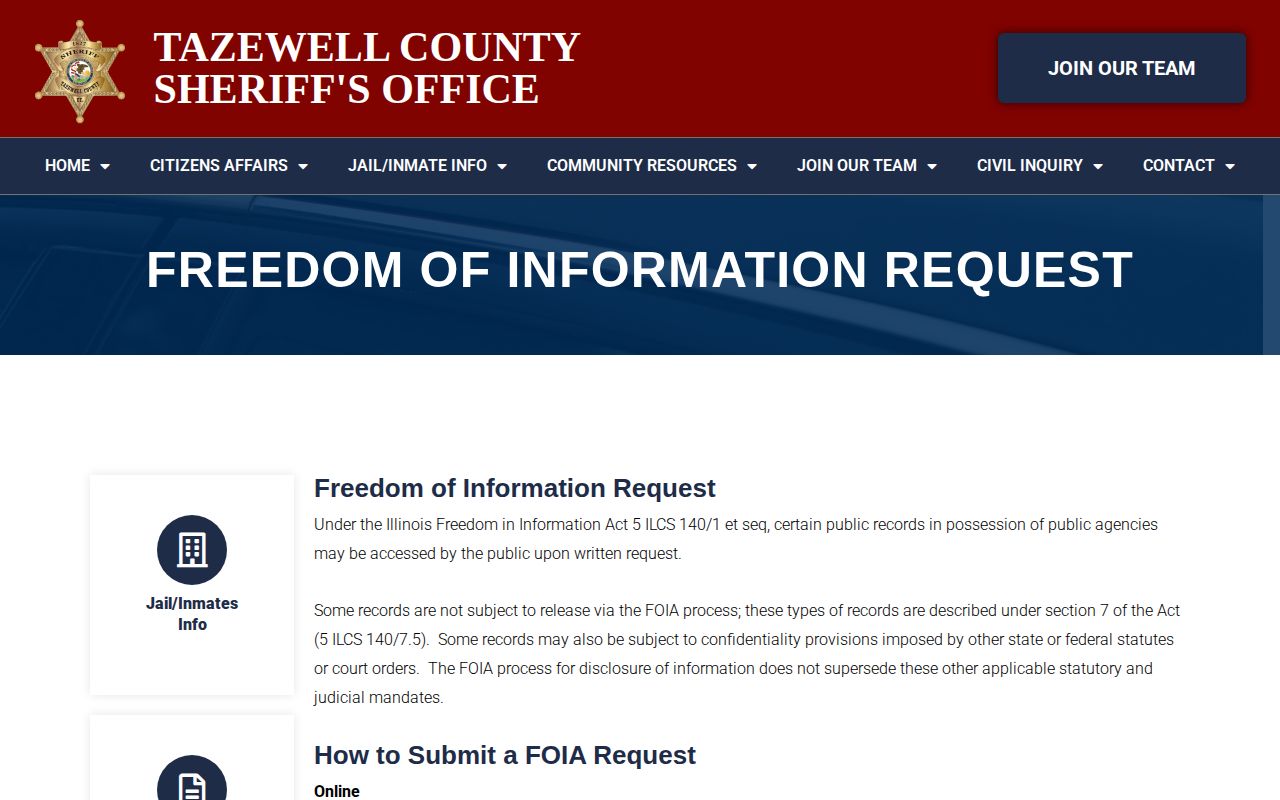
Use its stated channels and ask for a defined record set, not a newly created public release feed.
Tazewell Roster Data Quirks
Tazewell and IDOC handle visibility in opposite ways. The Sheriff table is current custody only, so a released or transferred person drops outside its purpose. IDOC says its public offender search continues to cover people currently incarcerated or on parole. A state prisoner who has left confinement for parole or mandatory supervised release may remain visible with status or location plus admission, release, and sentencing information.
Once the state sentence is complete, the public IDOC profile is no longer displayed. The fallback is the IDOC contact form with “Record Search,” full name, date of birth, approximate admission year, and any known facility, conviction county, or incarceration dates. This is not the route for an ordinary Tazewell jail discharge. The Sheriff holds that county release record. The distinction is vital when a three-day set includes a transfer to IDOC rather than a return to the community.
- Released from county jail
- Confirm through the Sheriff’s date, time, authority, and disposition.
- Transferred to IDOC
- Continue with the state offender search because custody did not end.
- Released to parole
- The IDOC profile may remain public while state supervision continues.
- Sentence completed
- Use IDOC’s archived Record Search when the public profile has disappeared.
Reconcile Tazewell Release Results
Three-day work often joins several kinds of evidence. The Tazewell Circuit Clerk docket can explain a release order, dismissal, sentence, transfer-producing prison commitment, probation term, or later warrant. Remote court access is limited, and a docket event is not proof of the precise moment someone walked out. The Sheriff entry supplies the physical release time and authority.
Illinois VINELink can support a one-person custody-status check or notice through participating agencies. It does not provide a fixed Tazewell 72-hour archive and does not replace the release log. For a federal transfer, use the federal docket, USMS records, or BOP locator as appropriate. Tazewell’s published USMS agreement specifically allows federal detainees to be handed to the committing federal agency or a deputy marshal, which is not community release.
- Match names with identifiers, not name alone.
- Read the exact disposition or transfer label.
- Compare the Sheriff timestamp with the court event.
- Follow the receiving agency when custody continued.
- Treat “no result” as unresolved until the correct custodian is checked.
Choose the Tazewell Release Window
The 72-hour method fits a full three-day period and is more forgiving when the likely date is uncertain. It is not more authoritative than the same-day method. Both depend on the same underlying Sheriff entries because neither has a public feed. The difference is the interval named in the request and the amount of reconciliation that may be needed.
Use the Tazewell County 24-Hour Release List process when the question concerns today or one exact day. For one named person whose date is unknown, the Tazewell County released-inmate lookup maps the county, court, IDOC, VINE, and federal paths. Keep current custody separate from past release in every route.
| Question | Best starting point |
|---|---|
| Who left during one exact day? | Existing Sheriff release entries for a precise 24-hour interval. |
| Who left across three days? | Existing Sheriff release entries for a precise 72-hour interval. |
| Is the person still in the county jail? | Current Sheriff custody table. |
| Did the person enter state custody? | IDOC offender search and records route. |
| Was this a federal handoff? | Federal docket, USMS records, or BOP locator. |